
Services and Engineering
Plastic Injection Tooling
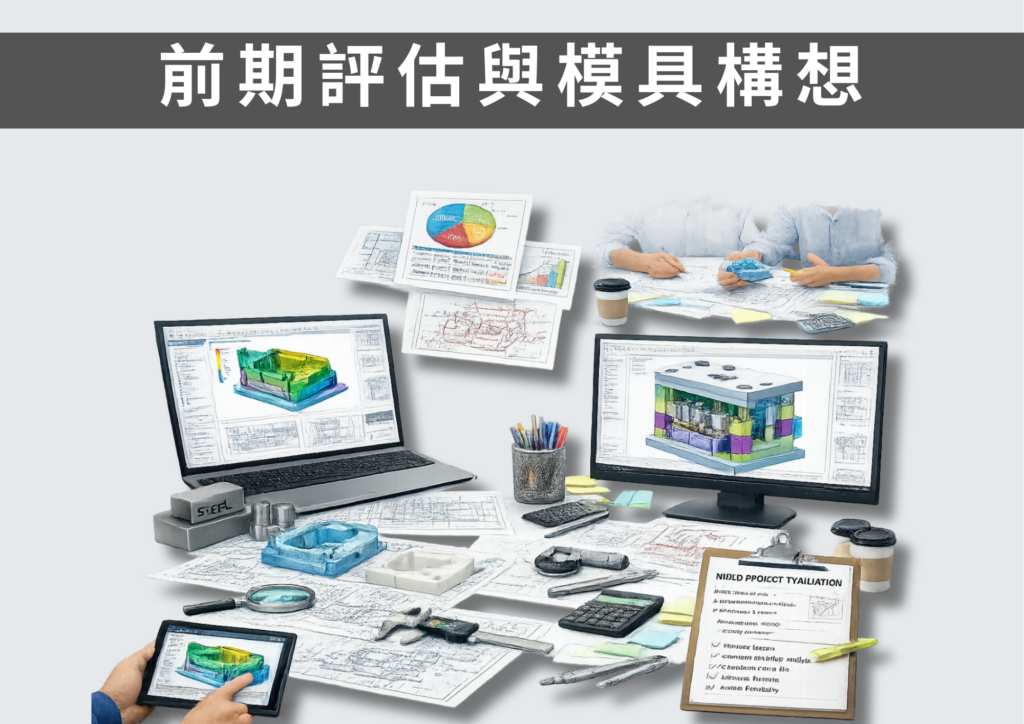
1. Early-Stage Evaluation & Mold Conceptualization
Upon receiving customer drawings or samples, Ding Shun begins by evaluating the project from a DFM (Design for Manufacturing) perspective, focusing on moldability and determining the most stable approach for mold design and construction.
We prioritize a thorough understanding of your product's purpose, functional requirements, and intended operating environment—such as medical applications, precision-fit components, or high-aesthetic visual parts.
We thoroughly examine structural features such as wall thickness, ribs, snap-fits, and apertures to assess the potential for defects like sink marks, warping, or assembly interference.
We determine the optimal parting line and draft angles, while evaluating the necessity for complex tooling mechanisms such as sliders, side-actions, or lifters.
We also determine essential tooling parameters, such as mold grade and cavity count (single-cavity or multi-cavity), based on the projected production volume and the expected service life of the mold.
At this stage, Ding Shun offers professional design optimization suggestions. By recommending strategic adjustments—such as refining wall thickness, rib height, or draft angles—we ensure the final mold design is more robust, significantly extends tool life, and simplifies future maintenance.
.
2. Mold Design & Engineering Planning
Once the fundamental direction is confirmed, Ding Shun’s engineering team assumes full responsibility for the overall mold structural design, focusing on the following key areas:

Parting Line and Mold Opening Strategy:
We carefully plan the parting line placement to minimize its visibility on aesthetic surfaces. Additionally, we ensure that the mold opening sequence is optimized for smooth operation while eliminating any potential mechanical interference.

Cavity Layout and Gating Strategy:
We strategically plan cavity counts and insert configurations, alongside determining the optimal gate location and type. This approach ensures balanced material filling and flow distribution, while simultaneously maximizing mold longevity.

Mechanism Design:
We incorporate specialized mechanisms—including sliders, lifters, side-actions, and core-pullers—tailored to the product's structural requirements. Our design priority is to ensure smooth operation, robust mechanical strength, and ease of access for future maintenance and component replacement.

Cooling and Structural Rigidity:
During the design phase, we strategically integrate cooling channels and optimize mold base rigidity. This ensures minimal mold deformation during continuous operation, resulting in greater dimensional stability and extended tool service life.

Design for Maintainability:
We incorporate design features that anticipate potential modifications or repairs—such as local welding or machining—at the design stage. By avoiding overly restrictive structural designs, we ensure that the mold remains adaptable for future adjustments, thereby minimizing downtime and simplifying maintenance.

Robust Design Philosophy:
Our core design philosophy is built upon three pillars: structural robustness, longevity, and ease of maintenance. We prioritize long-term production reliability and sustainable performance over short-sighted goals that sacrifice operational durability and future serviceability.
(Strategic Partnership & Supply Chain Management)
3. Mold Fabrication & Assembly
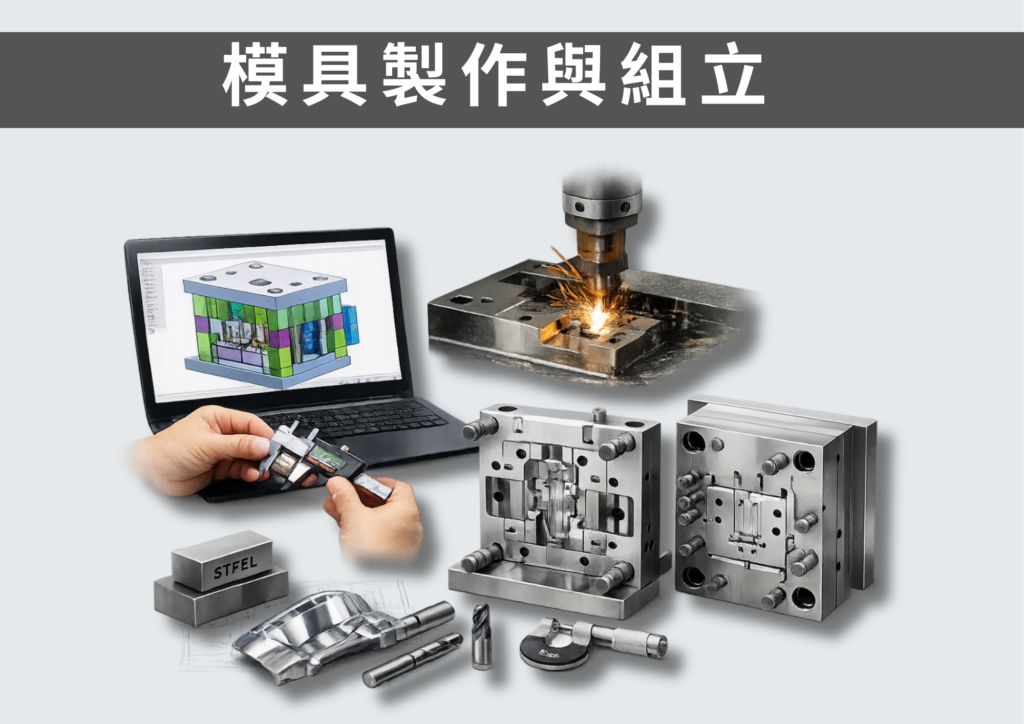
Ding Shun oversees the core processes, including mold design, final assembly, inspection, and pre-trial preparation. For precision machining, we partner with our long-term, specialized subcontractors to ensure the highest manufacturing standards.
In accordance with our engineering drawings, all critical components—including mold inserts, cores, cavities, and sliders—are manufactured by our long-term precision machining partners to ensure strict adherence to design specifications.
Ding Shun actively monitors the entire manufacturing process, conducting systematic progress tracking and critical dimension verification to ensure every component strictly conforms to design specifications.
In-House Assembly and Pre-Trial Inspection:
Once components are received, Ding Shun conducts the final assembly, including the fitting of cavity/core inserts, sliders, lifters, ejection systems, and guide pins/bushings.
Upon completion, we perform a comprehensive fundamental inspection of the mold assembly, specifically focusing on:
Smooth mold opening and closing cycles.
Verification of all moving components (sliders, lifters, and core-pullers) to ensure zero mechanical interference.
Proper functionality and reset accuracy of the ejection system.
The objective of this stage is to fully validate all mechanical actions before the mold reaches the molding machine. This rigorous pre-check significantly mitigates the risk of downtime caused by mechanical malfunctions during actual trial runs.
(Strategic Partnership & Supply Chain Management)
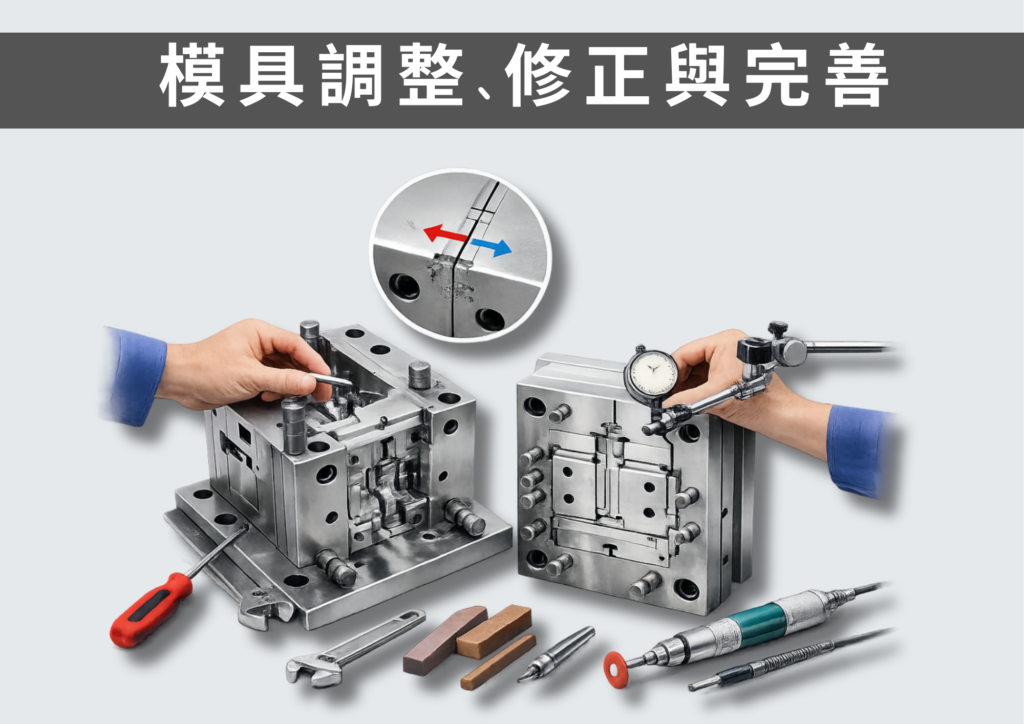
4. Mold Optimization, Correction, and Finalization
Should fine-tuning of dimensions, aesthetic optimization, or fit-and-function improvements be required after the initial trial, Ding Shun adopts a strategic 'prioritize mold modification, secondary structural adjustment' approach. This methodology ensures we address issues with maximum efficiency and minimal disruption, focusing on precision fine-tuning before escalating to more extensive structural changes.
For localized refinements, we handle specific requirements such as breaking sharp edges, adjusting EDM surface textures, and fine-tuning internal or external dimensions.
Based on actual operational performance, we further reinforce structural integrity or enhance fitting precision in specific areas as required.
By leveraging the design flexibility incorporated during the initial phase, we can address necessary modifications through techniques like localized welding and re-machining. This modular approach allows for targeted improvements, effectively avoiding the need for extensive, time-consuming, and costly redesigns of the entire mold.
Through this iterative refinement process, we ensure that our molds evolve to become increasingly mature, stable, and highly reliable for long-term production.
(Strategic Partnership & Supply Chain Management)
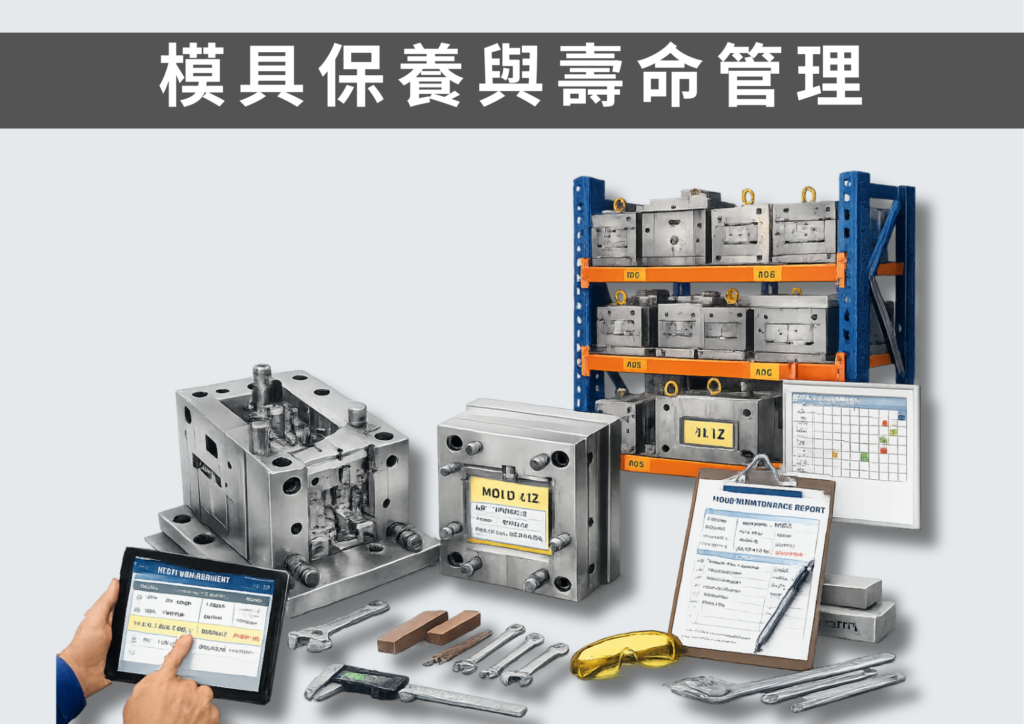
5. Mold Maintenance and Lifecycle Management
At Ding Shun, we view a mold not merely as a final product delivered, but as a critical asset that requires ongoing care and strategic management. To ensure this, we commit to the following:
- We recommend periodic cleaning of the cavities, venting channels, and parting lines to maintain optimal surface quality and ensure consistent production.
- We emphasize the importance of inspecting high-wear components, such as sliders, guide pins, bushings, and springs. We recommend timely replacement of these parts to prevent minor wear from escalating into major mold failure.
- For high-cycle molds, we implement structured maintenance schedules and detailed service logs. This ensures that every mold is verified to be in optimal condition before each production run, guaranteeing both consistency and reliability.
- For molds dedicated to medical or high-precision components, we implement rigorous protocols regarding anti-corrosion, contamination prevention, and comprehensive protective measures to ensure absolute cleanliness and product integrity.
By implementing a holistic management approach—encompassing design, fabrication, assembly, refinement, and maintenance—Ding Shun ensures that every mold delivers consistent, reliable performance throughout its entire operational lifecycle.